Every resident of Dubai must have health insurance. Without it, a residence visa cannot be issued or renewed. This guide explains who must insure whom, what the basic Essential Benefits Plan covers, what it costs, and how to choose a better plan for your family.
- Dubai Health Insurance Law No. 11 of 2013 makes cover mandatory for all residents.
- Employers must insure their employees and must not deduct the cost from salary.
- Sponsors must insure their dependants: spouse, children, parents and domestic workers.
- Employees earning AED 4,000 a month or less can be covered by the Essential Benefits Plan (EBP). Current EBP rates are about AED 643 to AED 826 a year.
- The reported fine for a lapsed policy is AED 500 per person for each month without cover.
- Since 1 January 2025, private-sector staff and domestic workers in every emirate must have cover.
Who Must Insure Whom in Dubai
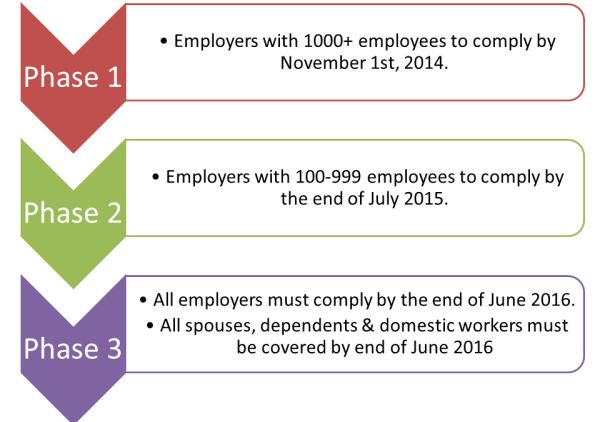
Dubai made health insurance compulsory under Law No. 11 of 2013. It was phased in between 2014 and 2016. Today, insurance is a condition for every residence visa issued in Dubai.
| Person | Who must pay for the insurance |
|---|---|
| Private-sector employee | The employer |
| Spouse and children | The sponsor (usually the employee) |
| Sponsored parents | The sponsor |
| Domestic worker (maid, nanny, driver) | The sponsor |
| Investor or self-sponsored resident | The resident |
Your employer must pay for your own cover. It cannot deduct the premium from your salary. Most employers do not have to insure your family, but some include dependants as a job benefit. Check your contract.
You must insure the people on your visa. If you sponsor your spouse, children or parents, you must buy a policy for each of them before their visa is issued or renewed.
The Essential Benefits Plan (EBP)
The EBP is the minimum level of cover in Dubai. It is designed for workers who earn AED 4,000 a month or less. The Dubai Health Authority (DHA) also says the EBP is the minimum standard for any health policy issued in Dubai. A more expensive plan must cover at least the same things.
What does the EBP cost?
DHA sets a price band for the EBP. Insurers must keep their rate within it. The band is AED 550 to AED 750 per person per year plus VAT and other charges. In March 2026, the 20 approved insurers listed rates of AED 643 to AED 826 a year, including VAT and the Basmah levy. You can see the current list on the ISAHD participating insurers page.
What does the EBP cover?
These benefits come from the DHA table of benefits that took effect on 1 January 2025:
| Benefit | What you pay (co-pay) | Limit |
|---|---|---|
| Annual limit | n/a | AED 150,000 per year |
| GP and specialist visits | 20% per visit (none for a follow-up within 7 days) | Specialist needs a GP referral |
| Lab tests, X-rays, MRI and CT scans | 20% | n/a |
| Hospital stay (non-urgent, pre-approved) | 20% | Capped at AED 500 per stay and AED 1,000 per year |
| Emergency treatment | Covered in all emirates | Within annual limit |
| Medicines | 30% per prescription | AED 2,500 per year |
| Physiotherapy | 20% per session | 6 sessions per year |
| Dental | 30% per visit | AED 500 per year |
| Outpatient mental health | 30% per visit | AED 800 per year |
| Antenatal care | 10% | 8 visits and 3 scans |
| Delivery (normal or C-section) | 10% | AED 10,000 |
| Newborn | Covered under the mother | First 30 days |
| Repatriation of remains | n/a | AED 5,000 |
Pre-existing conditions must be covered. An insurer can exclude treatment for a chronic or pre-existing condition for the first six months, but it must still cover an emergency. Hospital rooms are shared, and the network of clinics can be limited.
Plans for Salaries Above AED 4,000
If you earn more than AED 4,000 a month, your employer must give you a plan that is at least as good as the EBP. There is no fixed price. Most office jobs come with an “enhanced” plan that has a wider network, lower co-pays and sometimes cover outside the UAE.
Ask HR these questions on your first day:
- Which hospitals and clinics are in my network?
- What is the co-pay for a GP, a specialist and a prescription?
- Are my dependants covered, or do I need to buy their cover myself?
- Is there cover outside the UAE, for example on holiday or in my home country?
The UAE-Wide Mandatory Scheme (From 2025)
Since 1 January 2025, health insurance is compulsory for private-sector employees and domestic workers in all seven emirates. Before that, only Dubai and Abu Dhabi had compulsory schemes. The new rule mainly changed things in Sharjah, Ajman, Umm Al Quwain, Ras Al Khaimah and Fujairah.
| Point | Detail |
|---|---|
| Who it covers | Private-sector employees and domestic workers |
| Who pays | The employer or the domestic worker’s sponsor |
| Basic package price | AED 320 per year (Northern Emirates) |
| Link to visas | Required to issue or renew a work permit and residence visa |
| Dubai | Dubai keeps its own scheme. The EBP is the minimum. |
In 2026, the Ministry of Human Resources and Emiratisation (MoHRE) issued Ministerial Resolution No. 504 of 2026. It links insurance enrolment to work permits. MoHRE lists six employer violations. These include failing to insure or renew, charging the worker for the policy, and cancelling cover while the work permit is still valid. If your employer does any of these, you can report it to MoHRE.
Insurance for Dependants and Parents
You need a separate policy for each family member on your visa. For a spouse and children under the AED 4,000 salary band, the EBP is the cheapest legal option. Many families choose a better plan with access to their preferred hospitals.
Parents cost more. Premiums rise sharply with age, and insurers may ask older applicants for a medical declaration or recent medical reports. Expect to pay several thousand dirhams a year for an older parent, even on a basic plan. Comprehensive plans for seniors can cost much more. Get quotes from at least three insurers or a licensed broker before you apply for a parent’s visa.
Newborns are covered under the mother’s policy for the first 30 days. You must then enrol the baby on their own policy, either as a dependant or individually. Do this as soon as you have the birth certificate, because you need the policy for the baby’s residence visa.
Maternity Cover and Waiting Periods
The EBP covers antenatal care and delivery up to AED 10,000, with a 10% co-pay. The DHA table of benefits does not set a maternity waiting period.
Many insurers apply their own waiting periods on individual or enhanced plans. Brokers report waiting periods from zero to about 12 months, depending on the insurer and plan. Some policies also exclude a pregnancy that started before or shortly after the policy began.
If you plan to have a baby, take these steps:
- Ask the insurer in writing whether a maternity waiting period applies.
- Check the delivery limit. AED 10,000 may not cover a C-section at a private hospital.
- Confirm which hospitals in your network have maternity units.
Fines for Having No Insurance
DHA has reported a fine of AED 500 per person for each month without valid cover. The sponsor or employer pays it, not the employee. The fine is usually collected when the visa is renewed. Separate penalties apply to employers who deduct the premium from salaries.
The simplest way to avoid fines is to renew every policy before it expires. Set a reminder one month before each renewal date.
How to Choose a Health Insurance Plan
- Check the network first. A cheap plan is no use if your nearest clinic is not in it.
- Compare co-pays, not only the premium. A 20% co-pay on regular visits adds up fast.
- Look at the annual limit. AED 150,000 is the legal minimum. Many enhanced plans offer much higher limits.
- Check pharmacy limits. The EBP pays only AED 2,500 a year for medicines.
- Ask about cover outside the UAE if you travel often.
- Read the exclusions. Dental, optical and maternity rules differ most between plans.
Health insurance is also part of the paperwork when you arrive and leave. See our complete guide to moving to Dubai for the visa steps, including the Dubai medical fitness test. If you are leaving, our expat exit guide explains when to cancel your cover.
FAQ
Is health insurance mandatory in Dubai?
Yes. Under Law No. 11 of 2013, every Dubai resident must have health insurance. You cannot get or renew a residence visa without it.
Does my employer have to pay for my family’s insurance?
No. In Dubai, your employer must insure you. You must insure the dependants you sponsor, unless your contract says your employer will cover them.
How much is the cheapest health insurance in Dubai?
The Essential Benefits Plan is the cheapest legal option. In March 2026, approved insurers listed rates from about AED 643 to AED 826 a year, including VAT.
Who qualifies for the Essential Benefits Plan?
The EBP is for employees earning AED 4,000 a month or less, and for their dependants. People earning more must get a plan with at least the same benefits.
What is the fine for no health insurance in Dubai?
The reported fine is AED 500 per person for each month without cover. The sponsor or employer pays it.
Does Dubai health insurance cover pregnancy?
Yes. The EBP covers antenatal care and delivery up to AED 10,000 with a 10% co-pay. Many insurers apply their own waiting periods on other plans, so check before you buy.