Rain in the UAE is rare, but when it comes, it can be heavy. Roads drain slowly, underpasses fill and building drains overflow. A little preparation in October saves a lot of money and stress later.
This guide covers the season, the alerts, driving rules, car and home insurance, and what to do on a rainy day.
- Most UAE rain falls between November and March. The country gets roughly 100 mm a year on average.
- Follow alerts from the National Centre of Meteorology (NCM): yellow, orange and red.
- Entering a flooded valley or waterlogged area: AED 2,000 fine, 23 black points and 60-day impoundment.
- Third-party car insurance does not pay for rain damage to your own car. Comprehensive cover with natural perils usually does.
- For a claim in Dubai, get a "To Whom It May Concern" certificate from Dubai Police online.
- Your landlord fixes leaks in the building. Your own belongings need contents insurance.
When Does It Rain in the UAE?
The UAE’s main rainy period runs from about November to March. December to February is often the wettest stretch. October is usually dry, with an average of only about 5.2 mm of rain, according to the NCM. Summer rain does happen, but it is mostly in the eastern mountains near Al Ain and Fujairah.
The north and east of the country get more rain than the coastal cities. A wet year can bring several heavy days, while a dry year may bring only a few showers.
How NCM Weather Alerts Work
The National Centre of Meteorology issues colour-coded alerts on its website and app, and through official social media.
| Alert colour | What it means for you |
|---|---|
| Yellow | Weather may affect daily activities. Take care, especially on the road |
| Orange | More severe weather is expected. Be prepared and limit travel |
| Red | Hazardous weather of exceptional severity. Avoid travel unless needed |
Alerts are issued for rain, thunderstorms, strong winds, dust and fog. For severe events, you may also receive an emergency alert on your phone from the National Emergency Crisis and Disaster Management Authority (NCEMA).
Follow Dubai Police, the RTA and your emirate’s media office for road closures.
Driving in the Rain: Rules and Fines
Wet roads in the UAE are slippery, especially after a long dry spell when oil sits on the surface. Slow down and leave more space.
Key rules:
- Follow the electronic signs. Variable message signs can lower the speed limit in bad weather. The sign limit replaces the normal posted limit.
- Use dipped headlights when visibility is poor.
- Do not drive with hazard lights on. Use them only when you are stopped or broken down.
- Signal every lane change. Other drivers see less in heavy rain.
- Keep away from valleys (wadis), dams and flooded areas.
- Do not stop to film the rain or floods.
| Violation | Fine (AED) | Black points | Impoundment |
|---|---|---|---|
| Entering valleys or flooded areas during water flow | 2,000 | 23 | 60 days |
| Gathering or stopping near valleys, dams or flood areas during rain | 1,000 | 6 | – |
| Blocking traffic, ambulances or rescue teams during emergencies | 1,000 | 4 | 60 days |
| Driving with hazard lights on while moving | 500 | 4 | – |
| Using a phone to take photos while driving | 800 | 4 | – |
| Changing lanes without indicating | 400 | – | – |
The valley fine comes from Ministerial Resolution No. 227 of 2023. For the full list, see our Dubai traffic fines guide.
Before the season starts, check your tyres and wipers. Worn tyres lose grip quickly on wet roads. Our guide on how to maintain your car’s tyres in Dubai explains what to check.
Parking in Flood-Prone Areas
Some places flood every time it rains hard. Common risk spots are:
- Open-air basement ramps and underground car parks
- Low-lying streets and service roads next to main roads
- Underpasses and dips under bridges
- Parking lots next to construction sites with poor drainage
When heavy rain is forecast:
- Move your car to a higher level of a multi-storey car park, if you can.
- Avoid parking under trees, cranes or loose signs in strong wind.
- Do not leave the car in a basement that has flooded before.
- Take photos of where and how you parked. These help if you need to claim.
If water reaches your car, do not start the engine. Water in the engine can cause major damage when you crank it. Call your insurer’s roadside service and have it towed.
Car Insurance: Does Comprehensive Cover Flood Damage?
This is the question most drivers ask after a storm. The answer depends on your policy type.
| Policy type | Rain or flood damage to your own car |
|---|---|
| Third-party only (legal minimum) | Not covered. It pays only for damage you cause to others |
| Comprehensive without natural perils | Often not covered. Check the exclusions |
| Comprehensive with natural perils or natural calamity cover | Usually covered, subject to conditions |
Common conditions that insurers apply:
- Parked versus driven. Some insurers pay only if the car was parked when it was damaged. Driving into flood water can lead to a rejected claim.
- Official declaration. Some policies count an event as a natural calamity only if the authorities declare it.
- Excess. You may still pay an excess (deductible) on each claim.
Read your policy schedule now, before the season starts. If natural perils cover is an add-on, ask your insurer for the price. If you are buying a car, see what expats should know before owning a car in Dubai.
How to Claim for Rain Damage in Dubai
- Make sure you are safe. Do not walk or drive through deep water.
- Take photos of the car, the water level and the location.
- Get a police certificate. In Dubai, apply for a “To Whom It May Concern” certificate for natural disasters. Use the “Certificates Package” service on the Dubai Police website or app and upload photos of the damage. It is usually issued within one working day. Earlier reports put the fee at about AED 95.
- Contact your insurer and give the policy number, the certificate and photos.
- Send documents. Insurers usually ask for your driving licence, vehicle registration (mulkiya) and Emirates ID.
- Wait for the survey. The insurer inspects the car and approves repairs at an agency or approved garage.
In other emirates, contact the local police for the right report or certificate.
Protect Your Home Before the Rain
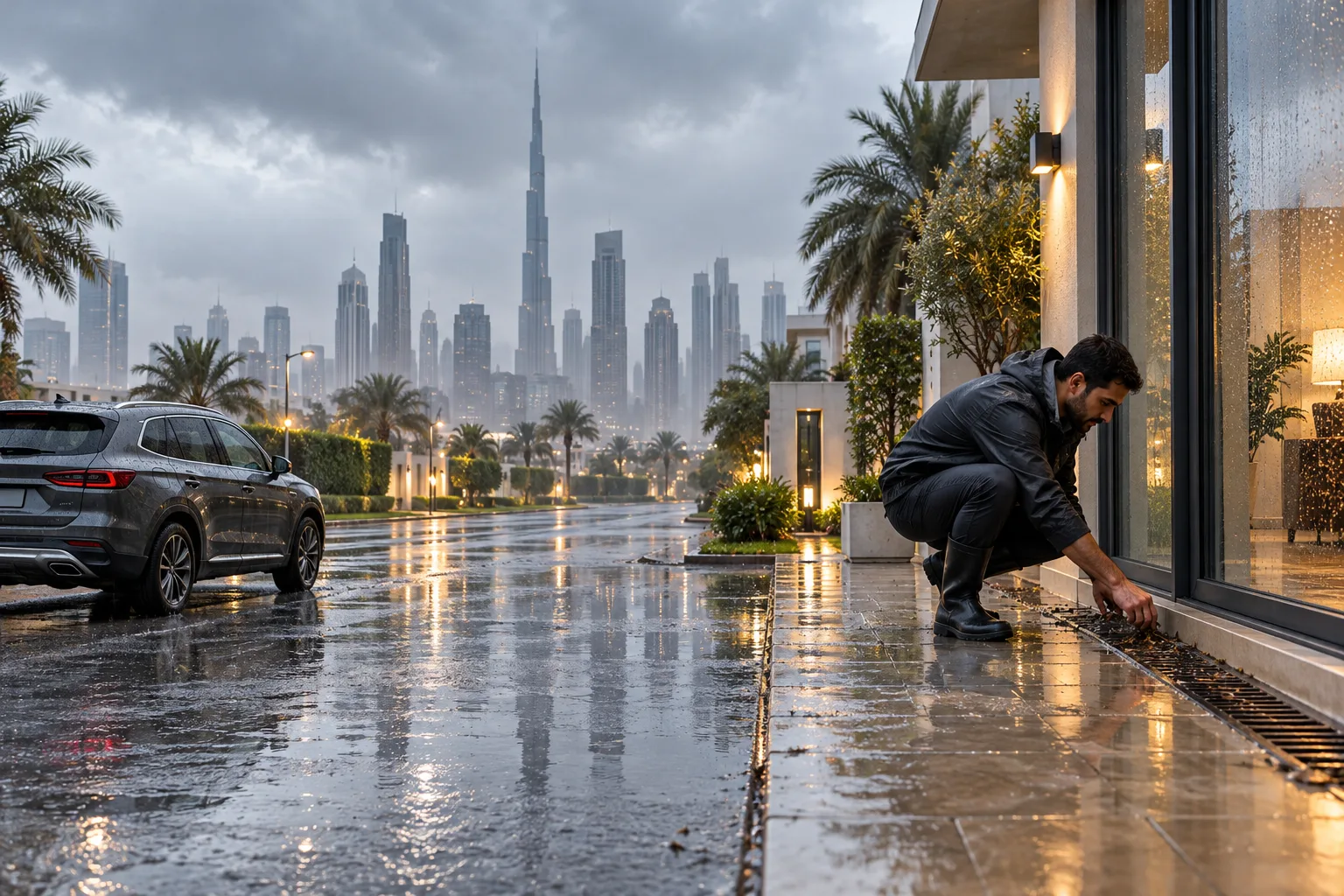
Most rain damage in homes comes from blocked drains, not from the rain itself. Do these checks in October:
- AC drain pipes. Check that the AC condensate pipes are clear. Blocked pipes drip inside after rain and humid days.
- Balcony drains. Remove leaves, dust and stored items from the floor drain. A blocked balcony drain can send water into the living room.
- Windows and sliding doors. Look at the rubber seals and the track drain holes. Clean sand out of the tracks.
- Roof and terrace (villas). Check that gutters and roof drains are clear. Look for cracks in the waterproofing.
- Valuables. Move electronics and important papers off the floor in ground-floor flats and villas.
- Photos. Take dated photos of your home and belongings for any later claim.
Tenant vs Landlord: Who Pays for Water Damage?
Under Dubai’s tenancy law (Law No. 26 of 2007, Article 16), the landlord must carry out maintenance and fix defects that stop you from using the home, unless the contract says otherwise.
| Issue | Usually responsible |
|---|---|
| Roof leaks, building waterproofing, main drains | Landlord or building management |
| Faulty internal plumbing and water heaters | Landlord |
| Blocked balcony or sink drains from daily use | Tenant |
| Minor repairs below the contract threshold | Tenant, if the contract says so |
| Your furniture, clothes and electronics | Tenant (through contents insurance) |
Read your tenancy contract. Many contracts set a cost limit for minor repairs that the tenant pays.
If water comes in, report it to the landlord or management in writing, with photos, the same day. If the landlord does not act, you can file a complaint at the Rental Dispute Centre. For more on your rights, see our guide to Dubai rent increase rules and tenant rights.
Contents Insurance for Tenants
The landlord’s building insurance covers the structure, not your belongings. If water damages your sofa, laptop or clothes, you pay unless you have contents insurance.
When you buy a policy, check:
- Whether storm, flood and water ingress are covered or excluded
- Whether escape of water (burst pipes, AC leaks) is covered
- The excess on each claim
- Whether temporary accommodation is included if the home is unusable
Remote Work Days During Heavy Rain
During unstable weather, the government often announces remote work for some days. The pattern in recent years is:
- Federal and Dubai government staff move to remote work, except for jobs that need people on site.
- Private companies are encouraged, not required, to allow remote or flexible work. The Ministry of Human Resources and Emiratisation (MOHRE) issues this guidance.
- Schools may move to distance learning for a day or more.
Announcements usually come the evening before, through official media offices. Ask your employer now what its rainy-day policy is. Outdoor workers have extra safety rules during storms.
FAQ
When is the rainy season in the UAE?
Most rain falls between November and March, with December to February often the wettest period. October is usually dry.
Does comprehensive car insurance cover flood damage in the UAE?
Usually yes, if the policy includes natural perils or natural calamity cover. Third-party only policies do not cover damage to your own car.
What is the fine for driving into a flooded wadi in the UAE?
The fine is AED 2,000, 23 black points and 60 days of vehicle impoundment. Gathering near valleys during rain brings an AED 1,000 fine and 6 black points.
How do I get a police certificate for rain damage to my car in Dubai?
Apply for the “To Whom It May Concern” certificate for natural disasters on the Dubai Police website or app. Upload photos of the damage and pay the fee.
Is my landlord responsible for rain leaks in my apartment?
Generally yes, for the building, roof and main plumbing, unless the contract says otherwise. Your own belongings are your responsibility unless you have contents insurance.
Do private companies have to give remote work during rain?
No. The government usually encourages private employers to offer remote or flexible work, but it is not mandatory.