If you have just received a rent increase notice — or you are anxious about what happens at your next renewal — you are not alone. Rent is the single biggest cost for most Dubai expats, and landlords do not always play by the rules. The good news is that the rules exist, they are clear, and tenants who know them are in a strong position.
This guide covers what landlords can legally do, how to check whether your increase is valid, and exactly what to do if it is not.
Can Your Landlord Increase Your Rent?
Yes, but only within limits set by RERA (the Real Estate Regulatory Agency) and only with proper written notice given at least 90 days before your contract renewal date.
The benchmark for all rent increase decisions is the Smart Rental Index (previously known as the RERA Rental Index). This is an official register of fair market rents, broken down by area, building, and unit type across Dubai. Any increase that exceeds the caps set by the Smart Rental Index is illegal — regardless of what your landlord says the market is doing.
The critical question is not “has the market gone up?” — it is “how does your current rent compare to the Smart Rental Index figure for your specific property?” That gap determines everything.
The RERA Rent Increase Cap — How It Works
The increase your landlord can charge is determined by how far your current rent sits below the RERA benchmark for your unit. The cap is not a flat annual percentage — it is tied directly to that gap.
| Your current rent vs RERA index | Maximum allowable increase |
|---|---|
| Within 10% below index | 0% — no increase allowed |
| 11%–20% below index | Up to 5% |
| 21%–30% below index | Up to 10% |
| 31%–40% below index | Up to 15% |
| More than 40% below index | Up to 20% |
If you are already paying close to the market rate, your landlord cannot raise your rent at all — even if rents in your area have risen sharply over the past year. The cap applies regardless of what the general market is doing.
To check the index figure for your specific property, use the Smart Rental Index tool on the Dubai Land Department (DLD) website at dubailand.gov.ae, or download the Dubai REST app. Enter your building name, number of bedrooms, and area. The result gives you the official benchmark rent for your unit type — the number your landlord’s increase must be measured against.
Running this check takes about two minutes and is the single most useful thing you can do before any renewal negotiation.
The 90-Day Notice Rule
A landlord must give written notice of any rent increase at least 90 days before the tenancy contract renewal date. This is not a courtesy — it is a legal requirement under UAE tenancy law.
If you receive less than 90 days’ notice of an increase, you are legally entitled to renew at your current rent with no increase whatsoever. The short notice alone makes the proposed increase void.
Notice must be in writing. WhatsApp messages and verbal conversations do not qualify as formal notice under RERA rules. A valid notice is typically a registered letter or a signed written addendum to the contract. If your landlord calls to tell you about an increase, ask for it in writing — and note the date you receive the written notice.
Eviction — When Is It Legal?
Landlords can only evict tenants in Dubai for three lawful reasons, and all three require 12 months’ written notice delivered through a notary public:
- Personal use — the owner or a first-degree relative (parent, child, sibling) needs to occupy the property
- Sale of the property — the landlord intends to sell the unit
- Demolition or major renovation — approved by the relevant municipal authority
There is an important protection built into reason 2. If a landlord evicts you citing an intent to sell, they cannot then re-let the property to a new tenant for two years after you vacate. If they do, you have legal grounds to take action — and RERA takes this practice seriously because it has been used as a pretext to replace long-term tenants with higher-paying ones.
For any eviction to be valid, the 12-month notice must be formal and notarised. A message saying “I need the flat back” does not begin the clock.

Tenancy Contract Renewal — Your Rights
If your landlord proposes a rent increase that violates RERA rules and you reject it, your tenancy auto-renews on the same terms under UAE law. You do not have to vacate, and you do not have to accept an illegal increase.
Send your rejection in writing, citing Law No. 26 of 2007 (the Dubai Tenancy Law) and the Smart Rental Index calculation you ran for your property. Many landlords back down at this point — they count on tenants not knowing the rules.
Landlords also cannot unilaterally change other contract terms at renewal. If your contract permits pets, allows a certain parking arrangement, or is silent on a particular matter, those terms carry forward unless both parties agree in writing to change them. Any new restriction or additional fee proposed at renewal requires your consent.
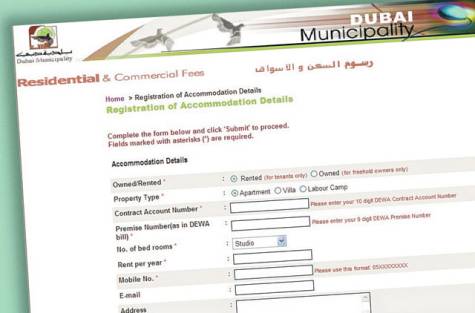
Beyond rent, keep in mind that your total housing costs also include the Dubai Municipality housing fee, which is charged as 5% of annual rent and billed through DEWA — worth factoring into any renewal calculation.
What to Do If Your Landlord Ignores the Rules
If your landlord insists on an illegal increase after you have raised the issue, follow these steps:
Step 1: Run the Smart Rental Index check on the DLD website and take a screenshot of the result for your specific building and unit type.
Step 2: Send a written response (email is acceptable; registered letter is stronger) rejecting the increase. Cite Law No. 26 of 2007 and the RERA index figure. Keep a copy.
Step 3: If the landlord persists, file a complaint with the Rental Dispute Centre (RDC) at the Dubai Courts website. Filing fees are 3.5% of your annual rent, with a minimum of AED 250 and a maximum of AED 20,000.
Step 4: The RDC mediates first, at no additional cost. If mediation fails, the case proceeds to a judge. Most straightforward cases — where the numbers clearly show an illegal increase — resolve at the mediation stage.
Initial mediation typically happens within three to four weeks of filing. Most landlords settle once they see an RDC case number, because they know they are on the wrong side of the law.
Common Landlord Tactics and How to Respond
“The market has gone up — everyone is paying more.” This is irrelevant to your case. Only the RERA Smart Rental Index figure matters, not anecdotal claims about what neighbours or new tenants are paying. Ask your landlord to show you the index figure — they usually cannot.
“Take it or leave it.” Call the bluff. RERA favours tenants in cases of illegal increases, and your tenancy auto-renews if you reject an unlawful proposal. You do not have to leave.
Withholding EJARI renewal. This is illegal. Your landlord is required to register the tenancy via EJARI regardless of any ongoing dispute. If they refuse, this is itself a ground for an RDC complaint.
“I need the property for my family.” Requires a formal 12-month notice delivered through a notary public. A verbal statement, a message, or even a letter that has not been notarised does not start the legal clock. Ask for the notarised notice in writing before you do anything.
FAQ
How do I find the RERA index for my apartment? Use the Smart Rental Index tool on dubailand.gov.ae. Enter your building name, number of bedrooms, and area. The result shows the official benchmark rent for your unit type — the figure your landlord’s increase must be measured against.
Can my landlord evict me because he found a tenant willing to pay more? No. A higher-paying prospective tenant is not a legal ground for eviction under Dubai tenancy law. Your landlord would need one of the three lawful reasons (personal use, sale, or demolition) with full 12-month notarised notice.
I signed a rent increase addendum under pressure — can I undo it? Possibly. Agreements signed under duress, or without proper advance notice, may be voidable. Consult the Rental Dispute Centre for advice — they can assess your specific situation.
Does RERA apply to all Dubai properties? Yes. All residential properties in Dubai that are governed by Ejari fall under RERA’s tenancy regulations. If your tenancy is registered through Ejari (as it legally must be), you have the full protection of these rules.