Moving to Dubai is complicated enough without adding a pet to the equation. But thousands of expat families do it every year, and the process — while paperwork-heavy — is entirely manageable if you start early and follow each step in sequence. This guide covers exactly what you need to do in 2026 to bring your cat or dog to Dubai, what it will cost, and what to expect when you land.
Can You Bring Any Pet to Dubai?
Dogs and cats are both permitted in the UAE provided you have the correct documentation. However, the UAE bans certain dog breeds outright. If you own an American Pit Bull Terrier, Rottweiler, Staffordshire Bull Terrier, Japanese Tosa, or Neapolitan Mastiff, you will not be permitted to import your dog. If your breed is on or near this list, check with MOCCAE directly before making any plans — the authority publishes the definitive breed list on its website.
Rabbits are permitted with standard health documentation. Pet birds require a CITES permit if the species is listed under the Convention on International Trade in Endangered Species, plus an import permit from MOCCAE. Exotic animals, snakes, and birds of prey are heavily restricted and in most cases cannot be imported as personal pets. If you have an unusual species, contact MOCCAE before proceeding.

Step 1 — Microchip and Rabies Vaccination
The UAE requires every imported cat and dog to carry an ISO-standard 15-digit microchip. This microchip must be implanted before the rabies vaccination is administered — the sequence matters and inspectors check it. If your pet was vaccinated before being chipped, you will likely need to restart the vaccination timeline.
The rabies vaccine must have been given at least 30 days before the date of travel, and the most recent dose must not be more than 12 months old at the time of arrival. Puppies and kittens must be at least 16 weeks of age before receiving the rabies vaccine, which affects the minimum age at which they can travel.
Keep every vet record, including the microchip implantation certificate and vaccination booklet. You will need originals or certified copies at every subsequent step.
Step 2 — Rabies Titre Test (Blood Test)
For pets arriving from most countries, the UAE requires a rabies neutralising antibody titre test (RNAT). This blood test confirms that the rabies vaccine has produced sufficient immunity. The sample must be sent to an MOCCAE-approved laboratory — a standard commercial vet lab is not sufficient. MOCCAE maintains a list of approved labs on its website; common examples include IDEXX Laboratories (USA) and the Animal Health Trust laboratory (UK).
The result must show a level of at least 0.5 IU/ml. After receiving a passing titre result, your pet must wait a further three months before entering the UAE. This waiting period is the single biggest source of delays for relocating families, so factor it in early.
Pets originating from a small number of pre-approved low-risk countries — including Australia, New Zealand, the United Kingdom, and the United States — may be exempt from the titre test requirement. However, this list changes, and MOCCAE’s current country classification is the only authoritative source. Verify your country’s status at moccae.gov.ae before assuming you are exempt.
Step 3 — Health Certificate
Within 10 days of your travel date, a licensed veterinarian must examine your pet and issue a health certificate confirming the animal is fit to travel and free from signs of infectious disease. This document must then be endorsed by your country’s official government veterinary authority — the Animal and Plant Health Agency (APHA) in the UK, the USDA in the United States, or the equivalent body in your country.
The endorsement process can take several days depending on your country and the time of year, so book the vet appointment with enough lead time to allow for government processing. The health certificate is the primary document inspected on arrival in Dubai, so any errors or omissions will cause problems at the airport.
Step 4 — MOCCAE Import Permit
Before your pet can enter the UAE, you need an import permit from the Ministry of Climate Change and Environment (MOCCAE). Apply online at moccae.gov.ae at least 48 hours before your scheduled arrival. The fee is AED 200 per animal.
To complete the application you will need your pet’s microchip number, full rabies vaccination history, the titre test result (if applicable), and the details of the health certificate. Once approved, the permit is sent to you by email. Print a copy and carry it alongside your other documents — the MOCCAE inspector at the airport will want to see it.
Step 5 — Flying with Your Pet
In-cabin travel is available for small cats and dogs whose combined weight with carrier does not exceed 8 kg. Not all airlines permit in-cabin pets even within this weight limit, and policies change. Book early and confirm directly with the airline, as in-cabin pet spaces are limited.
Larger pets must travel in the temperature-controlled hold as manifest cargo. Emirates allows pets in the hold but does not permit pets in the passenger cabin. Etihad and flydubai have their own policies that should be confirmed at time of booking. If you prefer a managed service, specialist pet transport companies such as PetAir UAE and IAG Cargo can handle the full logistics from origin to Dubai, including documentation support. Expect to pay AED 800 to AED 2,500 for hold travel depending on the size of your pet, the airline, and your origin country.
On Arrival at Dubai Airport
Pets travelling in the cabin arrive with you through the passenger terminal. Pets in cargo are processed separately through the cargo facility, typically at Terminal 2. In both cases, an MOCCAE inspector will check your import permit, health certificate, vaccination records, and microchip by scanning the chip against the number on your documents.
The inspection fee is approximately AED 150 to AED 300. If your documentation is complete and consistent, clearance typically takes one to three hours. If there is any discrepancy — an incorrect microchip number, an expired vaccination, a missing endorsement — your pet may be held at the airport quarantine facility while the issue is resolved. Quarantine costs are charged to the owner and accumulate daily. This is why it is worth double-checking every document before you travel.
After Arrival: Registering Your Pet in Dubai
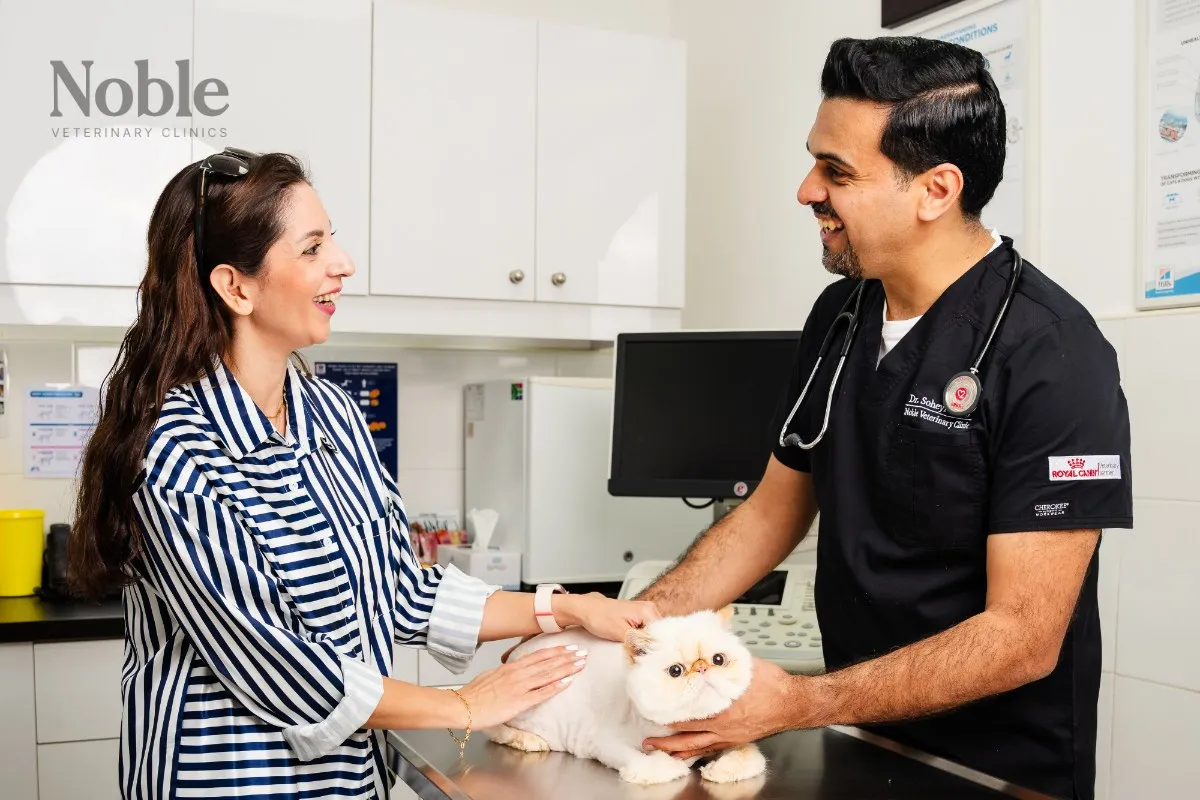
Once your pet is home, Dubai Municipality requires all resident dogs and cats to be registered. You can apply through the Dubai Municipality app or visit a customer service centre in person. The annual registration fee is AED 200 for dogs and AED 100 for cats. Proof of current rabies vaccination is required, and you will need to update this annually.
For ongoing vet care, Dubai has a strong network of qualified clinics. You can read more about cat vaccination schedules and what to expect from vets in Dubai if you are new to the system here. When you are ready to choose a regular practice, this guide to the top veterinary clinics in Dubai covers the leading options across different areas of the city.
Pet-Friendly Areas in Dubai

Not all parts of Dubai are equally welcoming to pets. JBR (Jumeirah Beach Residence) has a designated pet-friendly beach section where dogs are permitted. Popular villa communities including Jumeirah, Mirdif, Arabian Ranches, and The Meadows generally have gardens and nearby parks that suit pet owners well. Jumeirah Village Circle (JVC) has a growing number of pet-friendly apartment buildings, but policies vary by landlord and building management — always confirm before signing a lease.
Approximate Costs Summary
The table below gives realistic AED ranges for the main expenses involved in bringing a pet to Dubai. Costs vary by country of origin, pet size, and service provider.
| Item | Estimated Cost |
|---|---|
| Microchip implantation (if not already done) | AED 100 – 250 |
| Rabies vaccination | AED 150 – 350 |
| Rabies titre test (RNAT) | AED 500 – 1,200 |
| Health certificate (vet fee) | AED 300 – 700 |
| Government health certificate endorsement | AED 100 – 400 |
| MOCCAE import permit | AED 200 per animal |
| Airline cargo fee (hold travel) | AED 800 – 2,500 |
| Airport inspection fee | AED 150 – 300 |
| Dubai Municipality registration (annual) | AED 100 – 200 |
| Annual vet visits and vaccinations in Dubai | AED 400 – 900 per year |
These figures are estimates. Your actual costs will depend on which country you are travelling from, your pet’s size and health history, and whether you use a pet relocation agent.
Taking Your Pet Out of Dubai (Export)
If you eventually relocate out of Dubai, your pet will need an MOCCAE export certificate, which costs approximately AED 100 to AED 200. Your destination country will impose its own import requirements — for example, the United Kingdom requires microchip scanning on arrival, a current health certificate, and tapeworm treatment within 120 hours of entry. Some countries impose quarantine periods regardless of vaccination status.
Start the export process at least four to six weeks before your planned departure date. Requirements change, so check with your destination country’s veterinary authority directly rather than relying on second-hand information.
Frequently Asked Questions
Can I bring my dog in the cabin on Emirates?
No. Emirates does not permit pets in the passenger cabin on any of its flights. Dogs and cats travelling on Emirates must travel in the temperature-controlled hold as cargo. If in-cabin travel is important to you, check other airlines that operate the same route.
What if my dog is a banned breed?
If your dog is one of the breeds prohibited in the UAE — American Pit Bull Terrier, Rottweiler, Staffordshire Bull Terrier, Japanese Tosa, or Neapolitan Mastiff — it cannot be imported regardless of your paperwork. There is no exemption process for banned breeds. If you are unsure whether your dog qualifies as a restricted breed, contact MOCCAE directly before making travel plans.
How long does the whole import process take?
The minimum timeline is determined by the rabies vaccine and titre test sequence. The vaccine must be given at least 30 days before travel, and after a passing titre test result your pet must wait a further three months. In practice, most owners working from a country that requires the titre test need four to five months from the start of the process to the date of travel. If your country is on the MOCCAE pre-approved list and you are exempt from the titre test, the timeline shortens to approximately six to eight weeks from first vet appointment to travel date.
What happens if my papers are wrong at the airport?
If the MOCCAE inspector identifies a problem with your documentation — a mismatch in microchip numbers, an expired vaccine, a missing government endorsement — your pet will not be cleared for release. The animal will be held in the airport’s quarantine facility at your expense while the issue is investigated or corrected. In serious cases where documentation cannot be resolved, the pet may be returned to the country of origin. This outcome is rare but does happen. The safest approach is to have a qualified pet relocation agent review your documents before you travel.